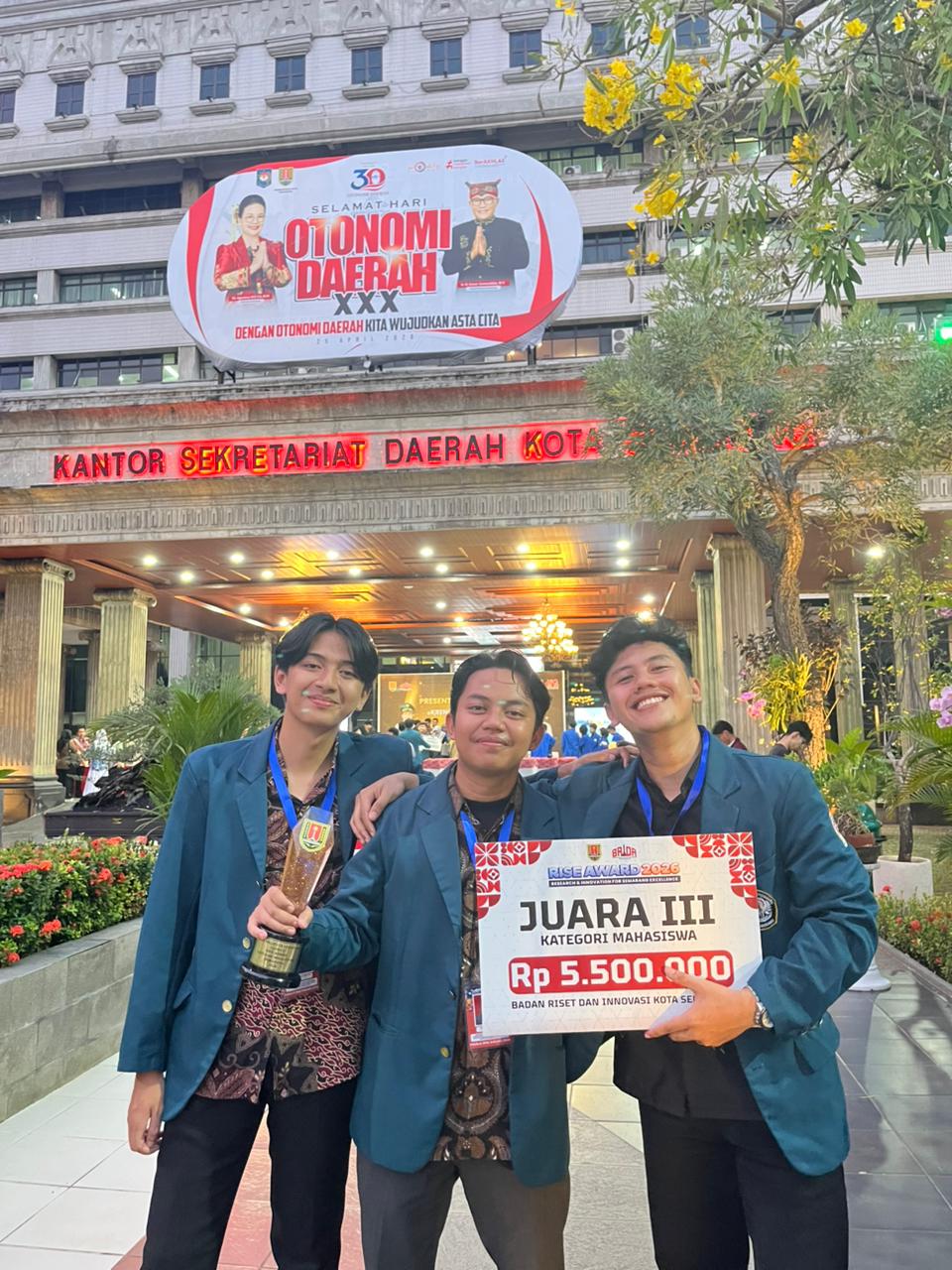

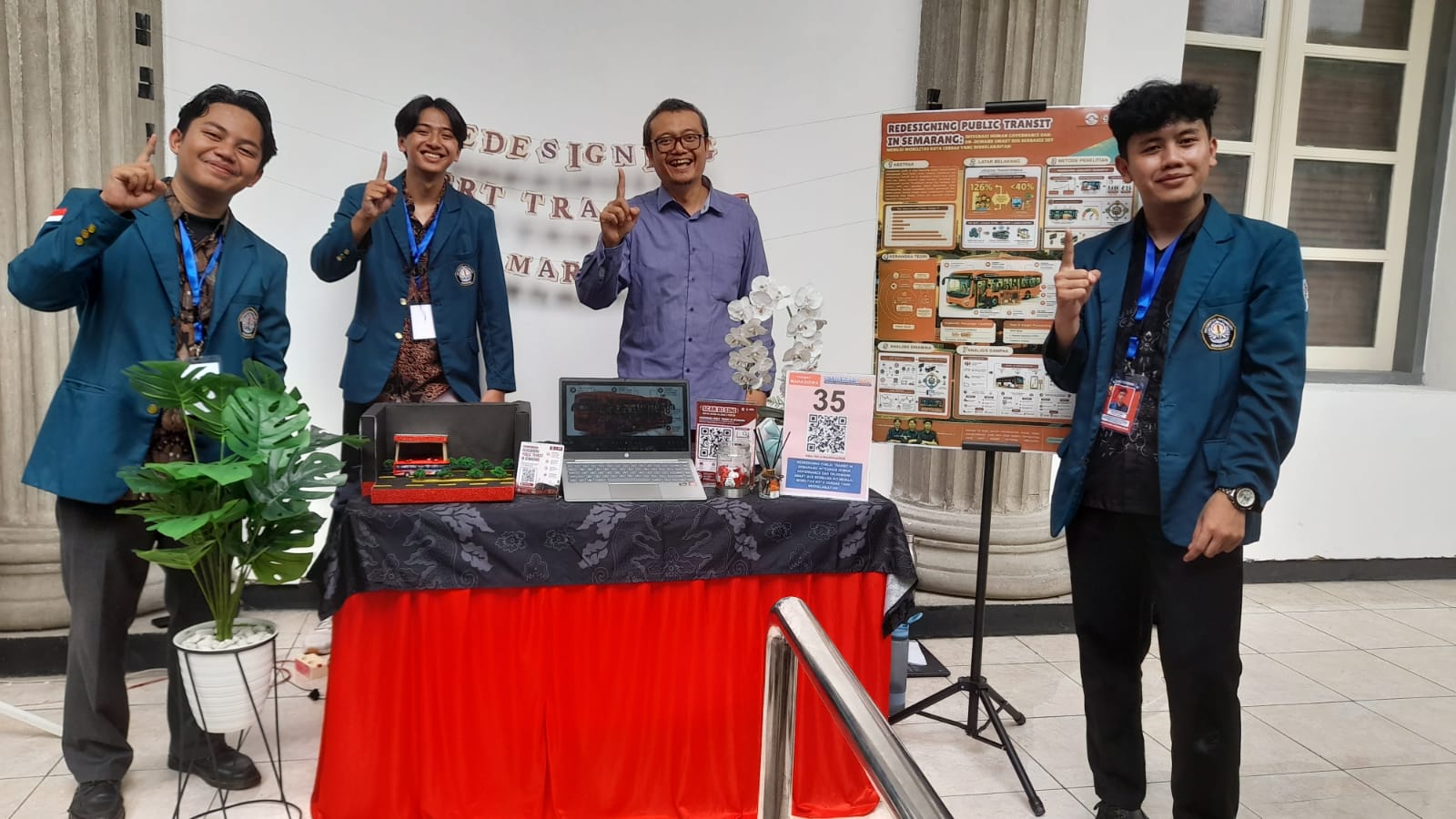
Tuesday, April 28, 2026, marked a proud moment for the Faculty of Social and Political Sciences (FISIP) at Diponegoro University (UNDIP). The team from the S1 Public Administration Study Program, FISIP UNDIP, through the Public Policy & Organization Management Laboratory, won 3rd place in the Research and Innovation for Semarang Excellence (RISE) Award 2026 organized by the Regional Research and Innovation Agency (BRIDA) of Semarang City. The team consisted of Almas Ghulam Riza, Muhamad Salman Abduloh, and Muhamad Nabih Zahi Nabbar, all of whom are students of the S1 Public Administration Study Program, FISIP UNDIP, class of 2023. The team was supervised by Dr. Johan Bhimo Sukoco, S.Sos, M.Si, a lecturer in the Department of Public Administration who also serves as the Coordinator of the Public Policy & Organization Management Laboratory.
The team outperformed 231 other participating teams in this prestigious annual competition. From these hundreds of participants, BRIDA Semarang City, through the Decree of the Head of the Regional Research and Innovation Agency of Semarang City Number: B/1987/000.9/IV/2026, announced the names of the top ten finalists for the RISE Award 2026. The team from the S1 Public Administration Study Program, FISIP UNDIP, advanced to the subsequent stages, including expo judging and presentations in front of the jury, ultimately successfully winning 3rd Place in the Student Category. The team received an award consisting of a trophy and development funds amounting to Rp 5,500,000.00 from BRIDA Semarang City.
The team proposed a public service innovation in the transportation sector, with the research title: “Redesigning Public Transit in Semarang: Integrating Human Governance and IoT-Based On-Demand Smart Bus towards Sustainable Smart City Mobility.” This research-based innovation originated from their concerns regarding the passenger capacity of the Bus Rapid Transit (BRT), which is often overlooked by operators, resulting in overloaded BRTs. This condition naturally leads to passenger discomfort, thus falling far from the ideal state of human governance, which prioritizes humanizing humans in public services.